
Climate Change Challenges Preparedness: “We Are Not Well Enough Prepared”
We are living in a turbulent time, marked by growing security challenges. In this context, it is crucial to understand how climate change affects societal preparedness. That is why it was particularly relevant when the Norwegian Defence University College once again put climate and the green transition on the agenda this week as part of its total defence preparedness course.
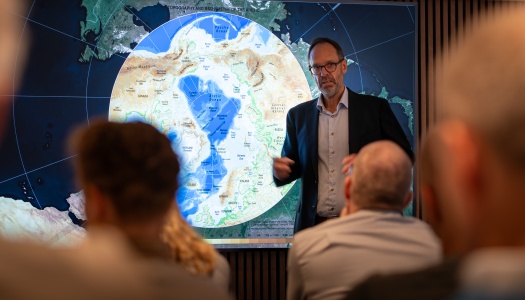
Director Jan-Gunnar Winther of the Centre for the Ocean and the Arctic delivered a lecture framed by the question: Climate change has major societal consequences—are we sufficiently prepared? The short answer is no, we are not prepared enough.
Long-term decisions in a rapidly changing climate
One of the main challenges is that rapid climate change makes long-term planning difficult. Spatial planning and investments in infrastructure must function for decades to come, yet decisions that make sense under today’s climate conditions may prove unsustainable in the long run.
An offshore wind turbine that is optimally located today may face poorer conditions in 10–20 years. A ski resort in coastal areas may become an economic liability in a warmer climate. Rebuilding homes in flood- and landslide-prone areas can result in the same costly damage recurring again and again.
The lecture therefore emphasized the importance of climate adaptation, and that it is often sound socio-economic policy to prevent damage rather than repair it. Although strained municipal finances make it challenging to prioritize costly measures today, early action will pay off over time. Knowledge about future climate conditions must therefore be integrated into today’s decision-making processes.
The ocean—both vulnerable and part of the solution
The ocean plays a central role in the climate context. It is vulnerable to warming and ecosystem changes, yet at the same time it can be an important part of the solution.
Restoration of marine ecosystems provides significant climate benefits. Re-establishing kelp forests along the Norwegian coast, for example, can help increase CO₂ uptake. So-called “blue forests” have a strong capacity for carbon storage, and several countries are now working to include the ocean’s carbon uptake in their national carbon budgets. This is being used both in follow-up of the Global Biodiversity Framework and in efforts to meet the goals of the Paris Agreement.
This development may create strong incentives for increased conservation and more sustainable management of marine areas—and help link nature policy and climate policy more closely together.
The Centre for the Ocean and the Arctic will continue to follow up on these issues through its ongoing work on climate, preparedness, and the ocean.